 By Vinod Saini
Last Updated on March 11, 2026 by Vinod Saini
If you’ve been trying to figure out why your website isn’t showing up on Google, SEO is probably the answer — and also the solution. Search Engine Optimization is simply the process of making your website easier for Google to find, understand, and trust. It combines better content, cleaner technical setup, and building credibility online. This guide walks you through what SEO actually is, how it works, the key types you need to know about, why it matters for your business, and how to build a strategy that moves the needle.
What Is SEO?
SEO — Search Engine Optimization — is how your website earns a spot on the first page of Google, Bing, or even YouTube, without paying for ads. You’re essentially helping search engines understand what your site is about, so they send the right people to it.
And those “right people” matter a lot. Google handles over 8.5 billion searches every day. The first result gets 27.6% of all clicks. Drop to position two and that falls to 15.8%. That’s a massive difference for just one spot.
What makes SEO genuinely worth your time is that it compounds. Unlike an ad that stops working the moment your budget runs out, SEO keeps delivering traffic. Sites that stay consistent with it see up to 14x more traffic over time compared to pages that are left unoptimized.
In 2026, the game has shifted a bit too. Google’s AI Overviews are changing how results look, voice search through Gemini is growing, and E-E-A-T — which stands for Experience, Expertise, Authoritativeness, and Trustworthiness — has become a real ranking consideration. Algorithms like RankBrain and the Helpful Content Update now care much more about whether your content actually helps people, not just whether it’s loaded with keywords.
How SEO Works?
Think of Google as a very thorough librarian. Before it can recommend your page to anyone, it needs to read it, understand it, and decide how good it actually is. Here’s how that plays out in four stages:
-
Crawling: Google sends out bots (called spiders) that travel the web through sitemaps and links, reading your page content along the way. They follow your robots.txt file and respect any noindex tags you’ve set.
-
Indexing: After crawling, Google stores your content in its massive index. It looks at your HTML, your text, your images — everything.
-
Ranking: This is where the real work happens. Google weighs over 200 factors — how relevant your content is to what someone searched, how many quality sites link to you, how fast your pages load, and how good the overall experience is for users.
-
Serving Results: Google then shows personalized results — organic listings, ads, featured snippets, AI Overviews — based on where the user is, what device they’re on, and what they’ve searched before.
One thing worth knowing: RankBrain, Google’s machine learning system, handles about 15% of daily searches that are completely new. It figures out what people mean — not just what they typed. And once your page is live and ranking, signals like how long people stay on it and how often they click through continue to shape where you land.
Key Areas of SEO
SEO isn’t just one big thing — it’s made up of five distinct areas, each one targeting a different part of the ranking puzzle:
-
On-Page SEO
-
Off-Page SEO
-
Technical SEO
-
Local SEO
-
Semantic SEO
Let’s break each one down.
What Is On-Page SEO?
On-page SEO is everything you control directly on your own page. That means your title tag, meta description, headers (H1 through H6), the actual content you write, and how your internal links are set up.
The most important thing here is matching what the user actually wants. Someone typing “what is SEO” wants a clear explanation. Someone searching “SEO services pricing” is probably ready to buy. Your content needs to match that intent — not just contain the keyword.
Work your primary keyword into your title early and keep it under 60 characters. Get it into the first 100 words of your content naturally — don’t force it. Tools like Yoast or SEMrush can help you check readability; a Flesch score above 70 means most people can read it comfortably. Pages that also use related terms like “organic traffic growth” and include images or videos tend to get up to 94% more views than text-only pages.
What Is Off-Page SEO?
Off-page SEO is about what happens outside your website — specifically, who’s linking to you and what they’re saying about you. Backlinks are still Google’s strongest external trust signal. When a site with real authority links to yours, it’s basically vouching for you.
The numbers back this up. The top-ranking pages for competitive terms often have 62,000+ referring domains pointing to them. You don’t need that many to get started, but the quality really does matter. A single link from a site like Forbes or Moz carries far more weight than dozens of links from random, low-quality directories.
Good ways to earn links include writing guest posts for reputable publications, responding to journalist queries on HARO, and finding broken links on other sites you can replace with your content. Social shares and brand mentions help too — pages with strong off-page signals rank around 2.2x higher on average.
What Is Technical SEO?
Technical SEO is the stuff users don’t usually see, but Google notices immediately. It’s about making sure your site is fast, secure, easy to crawl, and properly structured.
Start with HTTPS — it’s not optional anymore, and secure sites tend to have 40% lower bounce rates. Add structured data using JSON-LD schema markup to help Google understand your content better and unlock rich snippets, which can boost your click-through rate by up to 30%. Fix duplicate content issues with canonical tags, compress your images so they load quickly on mobile, and submit your XML sitemap through Google Search Console.
Core Web Vitals — Google’s speed and experience metrics — are worth taking seriously. Your Largest Contentful Paint (LCP) should be under 2.5 seconds. Sites that fail these metrics can see rankings drop by as much as 24%.
What Is Local SEO?
Local SEO is what gets your business found when people search for something “near me.” And that’s not a small slice of traffic — 46% of all Google searches have local intent.
If you run a business in Delhi, Gurugram, or anywhere else, your Google Business Profile is one of the most valuable things you can set up. Keep your Name, Address, and Phone number (NAP) consistent across every listing — Yelp, Yellow Pages, JustDial, wherever. Collect genuine reviews too. Local packs (the map results that appear at the top) show up in 84% of location-based searches, and they drive real foot traffic and phone calls.
What Is Semantic SEO?
Semantic SEO is about thinking beyond individual keywords and building real topical authority. Google’s Knowledge Graph connects entities — people, places, concepts — and your content strategy should reflect that same kind of depth.
Instead of writing one isolated article about “SEO,” build a cluster of content that covers everything related to it — ranking factors, voice search, zero-click searches, algorithm updates, and more. When your site shows that kind of depth and consistency, Google treats it as a genuine authority on the topic. That’s also what gets your content picked up by AI Overviews, which now summarize around 90% of informational queries.
Why SEO Is Important?
Here’s the honest truth: nothing else in digital marketing gives you quite the same return on investment as SEO. Organic search delivers roughly $11 back for every $1 spent. Compare that to social media or even email, and SEO still wins.
Beyond ROI, there’s a trust factor. Consumers trust Google’s organic results about 10x more than paid ads — and 75% of people scroll right past the ads entirely. If you’re not in the organic results, a huge chunk of your potential audience simply isn’t seeing you.
In competitive industries like digital marketing, SEO is also what keeps you stable through algorithm changes, ad cost spikes, and market shifts. With e-commerce growing 20% year over year, organic visibility is no longer a “nice to have” — it’s a real business asset.
Benefits of SEO
The results are hard to argue with:
-
Pages in position 1 get 53% of all traffic and convert 3x better than lower-ranked pages
-
Long-tail keywords like “SEO strategy for small business” make up 70% of searches and come with far less competition
-
Strong dwell time and a bounce rate under 50% tell Google your content is genuinely useful
-
Organic traffic keeps working even when your ad spend drops — it generates 5x more leads over the long run
-
Content optimized for AI Overviews captures zero-click traffic that traditional pages miss entirely
-
CompareSEO clients have seen traffic jump by 300% after a full audit
Crafting a Winning SEO Strategy
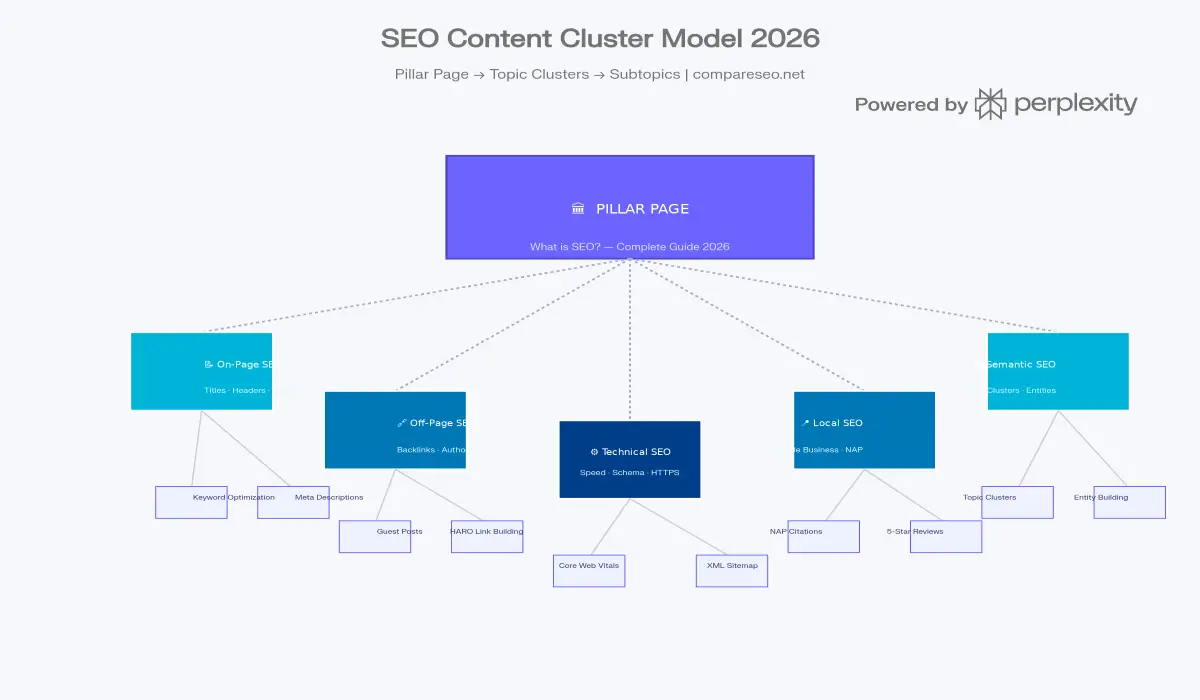
A good SEO strategy is built on data, not guesswork. Here’s a practical sequence that works:
-
Keyword research — Use Ahrefs or SEMrush to find opportunities your competitors are missing. Focus on queries with a keyword difficulty under 30 to start gaining traction faster
-
Technical audit — Run your site through Screaming Frog and Google Lighthouse. Fix crawl errors, broken links, and speed issues before anything else
-
Content clusters — Build one strong pillar page (3,500+ words) per topic and link it to a set of supporting articles that cover related queries in depth
-
Link building — Aim for at least 50 backlinks per month from domains with DA 50 or higher through consistent outreach
-
Track and adjust — Monitor your rankings, CTR, and conversions in Search Console every week, not once a quarter
AI tools like ChatGPT are genuinely useful for outlines and drafts — but always add your own expertise and real-world perspective before publishing. And revisit your older content regularly. Pages that go stale can drop 20% in rankings, so a quarterly refresh is worth building into your routine.
Actionable SEO Best Practices to Rank in Top 3
If you want faster wins, start here:
-
Add FAQPage and HowTo schema to eligible pages — structured data can lift traffic by 20% through rich snippets in search results
-
Go after featured snippets by formatting your answers as tables or bullet lists, especially for queries like “SEO ranking factors”
-
Include custom infographics explaining concepts like “how SEO works” — visual content earns 3x more backlinks than text alone
-
Make mobile performance a priority — 60% of searches happen on phones, and a slow mobile experience kills rankings
-
Build a clear internal linking structure using topic silos — it helps Google crawl your site more efficiently and can boost your crawl budget by up to 40%
Frequently Asked Questions (FAQs)
What is SEO in simple terms?
SEO is how your website earns higher rankings in Google search results — through better content, fixing technical issues, and getting other credible websites to link to you. The goal is free, consistent traffic that doesn’t disappear when you stop spending.
How SEO works for beginners?
Google visits your site, reads what’s on it, and decides how relevant and trustworthy it is for different search queries. The better your content, the faster your site loads, and the more quality sites that link to you — the higher you rank.
What is on-page SEO and why does it matter?
On-page SEO is optimizing your titles, headers, and content so they match what users are searching for and are easy to read. It directly influences around 25% of your total ranking factors, making it one of the quickest areas to see results.
What is off-page SEO with examples?
Off-page SEO is everything that happens outside your site to build authority. Getting a link from Moz, being mentioned in a Forbes article, or having your content shared widely on LinkedIn — these all signal to Google that your site is worth trusting.
What is technical SEO checklist?
The non-negotiables: HTTPS setup, mobile speed with LCP under 2.5 seconds, schema markup, an XML sitemap submitted to Search Console, and noindex tags on thin or duplicate pages you don’t want Google to rank.
How to build an SEO strategy from scratch?
Find keyword gaps in your niche, fix your technical foundation first, create content around topic clusters, earn quality backlinks through outreach, and review your analytics weekly so you’re always making decisions based on real data.
🚀 Get Your Free Technical SEO Audit
We'll identify critical issues hurting your rankings — delivered in 24 hours, no obligation.
Get Free Audit →