
Last Updated on July 14, 2026 by Vinod Saini
- SEO vs SEM: The Core Difference
- SEO vs SEM: 2026 Data Comparison
- SEO Advantages: Sustainable Growth That Compounds
- SEM Advantages: Speed and Precision When You Need It
- SEO vs SEM ROI: The Honest Numbers
- SEO vs SEM in the AI Overviews Era
- Hybrid Strategy: The Optimal Approach
- Actionable Framework: SEO, SEM, or Both?
- Frequently Asked Questions
- Related Strategy Guides
Quick Answer: SEO generates 53.3% of all website traffic with a median 748% ROI ($22 per $1 invested) — but takes 6-12 months to show results. SEM delivers top visibility in 24-48 hours with 150-300% short-term ROI — but stops the moment you pause your budget. For Indian SMBs: SEO wins on cost per lead (₹2,500 vs ₹4,000-16,000+ for SEM) and long-term compounding. SEM wins on speed, precision targeting, and testing. The optimal strategy for most businesses: 60-70% SEO + 30-40% SEM — with SEM data actively guiding which SEO content to build.
Key Takeaways
- SEO delivers 748% median ROI; SEM delivers 150-300% — but SEO takes 6-12 months to mature
- Organic search drives 53.3% of all website traffic; paid search drives ~20-30% of SERP clicks
- Strong SEO directly lowers your SEM costs — better landing pages = higher Quality Score = lower CPC
- AI Overviews appear in 31%+ of searches and are fuelled by organic SEO content, not paid ads
- 40% of searches are zero-click — structured SEO content builds brand visibility even without clicks
- Hybrid 60/40 SEO-SEM strategies report 2.3x traffic and 300%+ ROI vs single-channel
SEO vs SEM: The Core Difference
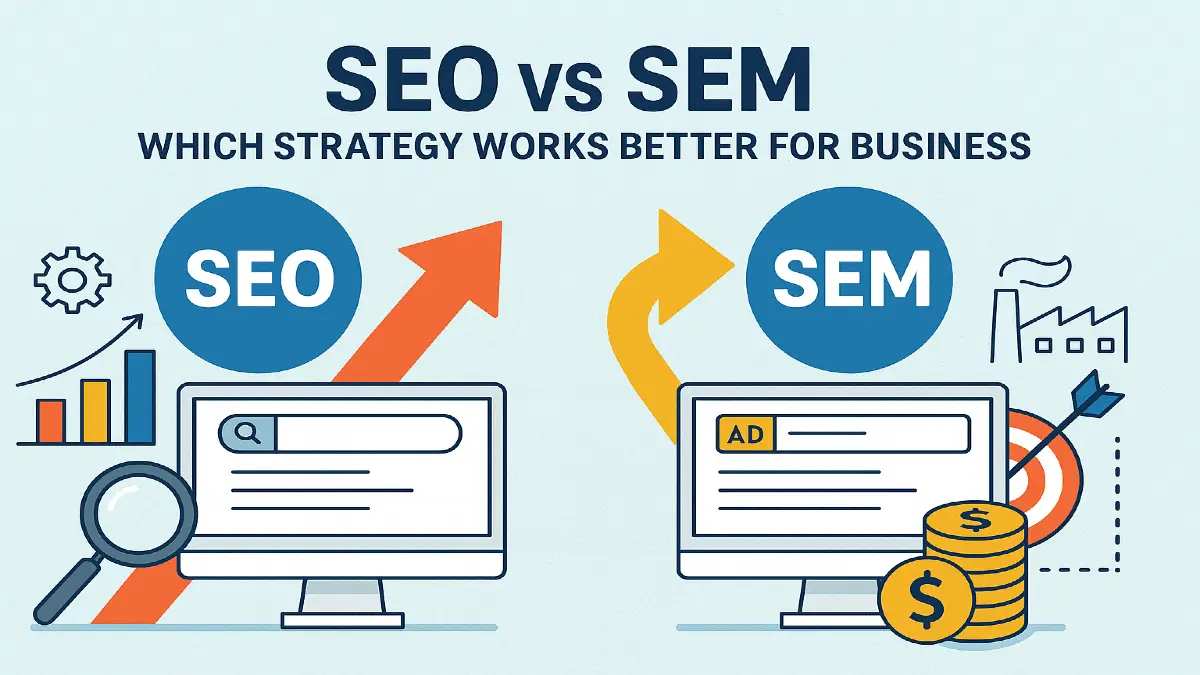
SEO (Search Engine Optimisation) improves your unpaid organic rankings through content quality, technical excellence, backlinks, and user experience. It’s an asset that builds and compounds over time.
SEM (Search Engine Marketing) is paid advertising — primarily Google Ads — where you bid for top positions. Instant visibility, but it stops completely when you stop paying.
SEO is planting a garden. SEM is renting prime real estate. Both are useful — the question is your timeline, budget, and goals.
SEO vs SEM: 2026 Data Comparison
| Metric | SEO | SEM |
|---|---|---|
| Traffic Share | 53.3% of total website traffic | ~20–30% of SERP clicks (top ad positions) |
| Cost per Lead | ~$31 average (84% lower than industry avg) | $50–200+ depending on competition |
| Time to Results | 6–12 months for strong rankings | 24–48 hours after campaign launch |
| ROI | Median 748% ($22 per $1 invested) | 150–300% short-term |
| Sustainability | Evergreen — compounds once ranked | Stops immediately when budget ends |
| AI Overviews | Directly fuels AI Overview citations | Paid ads not included in AI Overviews |
| Best For | Long-term growth, SMBs, content authority | Product launches, seasonal spikes, demand testing |
SEO Advantages: Sustainable Growth That Compounds
SEO builds value that keeps paying off:
- Long-tail keyword dominance — queries like “SEO vs SEM for small business India” convert 2.5x better than head terms because they match precise intent. SEO can target thousands of these simultaneously.
- Topical authority — a cluster of interlinked articles signals Google expertise across an entire subject area, not just a single keyword
- AI Overview citations — structured content with FAQPage schema, direct-answer H2 section openers, and E-E-A-T signals gets cited in Google AI Overviews, generating brand visibility even for zero-click searches
- Compounding value — a well-ranked page from 2024 still drives traffic in 2026 without additional spend
The challenge: Algorithm updates can shift rankings, and strong results typically require 6–12 months of consistent work.
📖 Related: AI SEO Strategy 2026 | How to Rank in Google AI Overviews
SEM Advantages: Speed and Precision When You Need It
SEM shines in scenarios where speed matters:
- Instant visibility — top ad positions within hours of campaign launch. Critical for product launches, events, and seasonal demand spikes
- Precision targeting — demographics, devices, locations, remarketing audiences. SEM can recover 70% of abandoned carts via retargeting
- Demand testing — run Google Ads on 10 keyword variants for 2 weeks to discover which ones actually convert, then invest SEO content in the proven winners
The Quality Score connection most businesses miss: Strong SEO directly reduces your SEM costs. A well-optimised landing page from your SEO work improves your Google Ads Quality Score (which measures relevance, expected CTR, and landing page experience). A higher Quality Score reduces your CPC and improves your ad rank — even when you bid less than competitors.
SEO vs SEM ROI: The Honest Numbers
SEO ROI: Median 748% ($22 return per $1 invested), with B2B SaaS hitting 702% after approximately 7 months of consistent work. The ROI compounds indefinitely once rankings are established.
SEM ROI: 150–300% short-term, requiring continuous spend. Strong for e-commerce and high-intent service queries. 50% of SEM spend is typically wasted on unoptimised keyword targeting — proper account management is essential.
For Indian SMBs: The ₹15,000–30,000/month typically available for digital marketing goes further in SEO. A well-executed SEO strategy at that budget level typically outperforms equivalent SEM spend by month 8–12.
SEO vs SEM in the AI Overviews Era
Google AI Overviews fundamentally change the competitive landscape in SEO’s favour:
- AI Overviews appear in 31%+ of searches and pull content exclusively from well-structured organic pages — paid ads don’t appear in AI Overviews
- 40% of searches are now zero-click — users get answers from AI Overviews without clicking any link
- For SEO: content cited in AI Overviews generates brand visibility even without clicks. A user seeing “Compare SEO recommends…” in an AI Overview becomes a warm lead when they later search branded terms
- For SEM: Google is expanding AI-powered ad formats, but organic AI Overviews don’t include paid placements
Verdict: In the AI Overviews era, SEO’s authority advantage has increased. SEM remains valuable for direct conversion intent, but the zero-click visibility that AI Overviews provide goes exclusively to organic content.
Hybrid Strategy: The Optimal Approach
The strongest digital marketing strategies combine both channels:
Budget allocation framework:
- 60–70% SEO — long-term foundation: content creation, technical improvements, link building
- 30–40% SEM — acceleration: test keywords, capture immediate demand, retarget organic visitors
The flywheel:
- Run SEM on target keywords to get conversion data quickly
- Build SEO content clusters around keywords that convert
- As SEO traffic grows, shift SEM budget toward newer keywords or remarketing
- SEO landing page improvements boost Quality Score, reducing SEM costs
Businesses using this hybrid approach consistently report 2.3x traffic and 300%+ combined ROI versus single-channel strategies.
Actionable Framework: SEO, SEM, or Both?
| Situation | Recommended Start |
|---|---|
| Indian SMB, limited budget (<₹30K/month) | Start SEO-first, add SEM for top 3 commercial keywords |
| New product/service launch | SEM for immediate visibility while SEO builds |
| E-commerce with seasonal peaks | SEM for peak seasons, SEO for year-round traffic |
| Established site with content gap | SEO content cluster + SEM for fastest pages |
| Service business (doctor, CA, lawyer) | Local SEO + Google Ads for near-me queries |
Frequently Asked Questions
What is the main SEO vs SEM difference?
SEO is unpaid organic rankings through content quality and authority — long-term compounding asset. SEM is paid Google Ads for instant top positions — visibility stops when budget ends.
Which is better for small businesses: SEO or SEM?
SEO for sustainable growth at lower cost (₹2,500 average cost per lead vs ₹4,000–16,000 for SEM). Start with SEO, layer SEM selectively for launches and high-intent commercial keywords.
How does SEO vs SEM ROI compare?
SEO: 748% median ROI once established. SEM: 150–300% short-term, requires continuous spend. SEO compounds; SEM needs ongoing budget.
How do AI Overviews change the SEO vs SEM equation?
AI Overviews appear in 31%+ of searches and are powered by organic SEO content — paid ads don’t appear in AI Overviews. SEO’s advantage over SEM has grown in the AI era.
Can businesses combine SEO and SEM?
Yes — the 60/40 hybrid approach consistently delivers 2.3x traffic and 300%+ ROI. SEM data guides SEO content investment; strong SEO landing pages reduce SEM costs via improved Quality Score.
Related Strategy Guides
- What is SEO? Complete Guide
- AI SEO Strategy 2026
- How to Rank in Google AI Overviews
- SEO Benefits for Business Growth
- Content Marketing Services
- SEO Services India
Want to know which strategy is right for your specific business? Get a free SEO + SEM strategy audit at CompareSEO.net — delivered in 72 hours.

Vinod Saini is an SEO Consultant, Technical SEO Specialist and SEO Content Writer with 15+ years of experience in search engine optimization and digital marketing. He specializes in Technical SEO, On-Page SEO, AI Search Optimization (AEO & GEO), Schema Markup, Core Web Vitals, Local SEO, and WordPress SEO. Through CompareSEO, he shares practical SEO strategies, industry insights, and actionable guides to help businesses improve their organic visibility and stay ahead of evolving search trends.