Last Updated on July 14, 2026 by Vinod Saini
- Why Traditional Quality Filters Were Failing
- S-CTS: Moving From Content Moderation to Cluster Termination
- Sentence-BERT: The AI Fingerprinting System
- How Google Adapts to New AI Models: LoRA and APO
- How to Future-Proof Your Content Strategy
- Frequently Asked Questions
- Related AI & SEO Strategy Guides
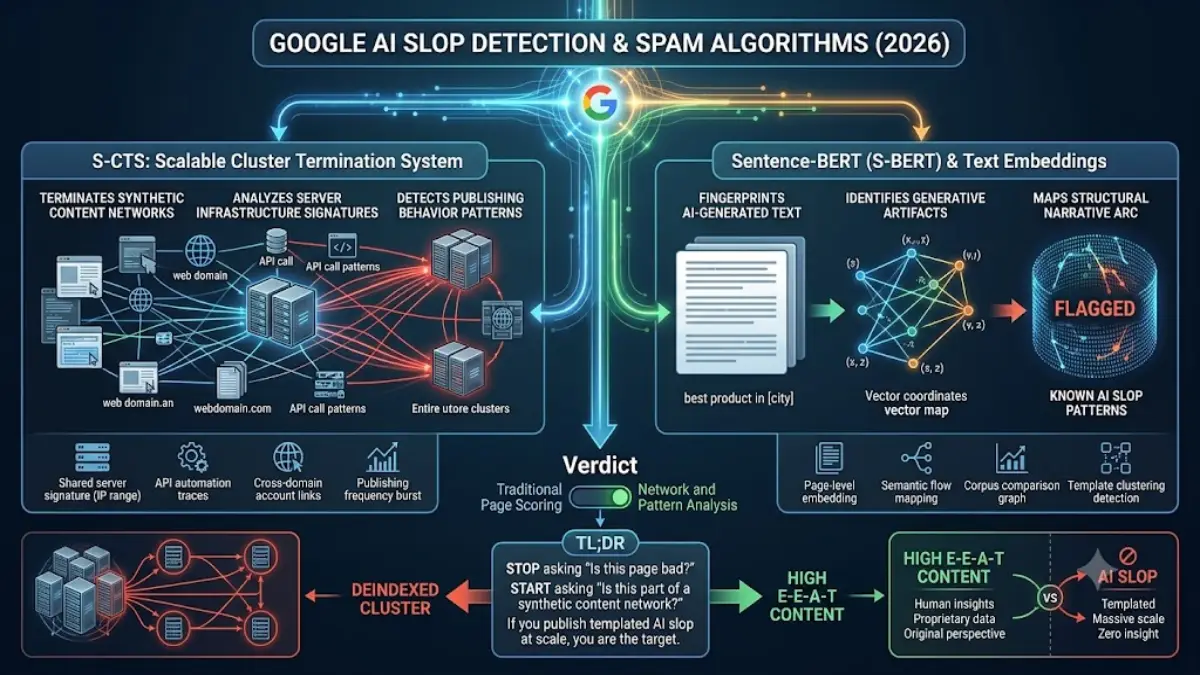
Quick Answer: Google uses two interconnected systems to detect AI content at scale. S-CTS (Scalable Cluster Termination System) doesn’t evaluate individual pages — it identifies entire networks of AI content generators by their infrastructure, publishing velocity, and cross-domain patterns, then terminates all connected sites simultaneously. Sentence-BERT (S-BERT) detects the mathematical “fingerprint” AI text leaves in its semantic structure — a signature that persists even after vocabulary changes or paraphrasing. Switching AI tools or rephrasing won’t help. Genuine human expertise and original structural narratives are the only reliable protection.
Key Takeaways
- Google’s S-CTS terminates entire content networks — not individual pages
- S-BERT detects the mathematical structure of AI text, not the vocabulary
- Paraphrasing AI output or switching tools does NOT avoid detection
- Google can detect new AI model outputs within days via LoRA and APO updates
- AI content with genuine human expertise and original data is not what these systems target
- Publishing 50+ articles in a week is a near-certain S-CTS velocity flag
- Indian publishers running multi-site portfolios on shared hosting are at highest risk
Why Traditional Quality Filters Were Failing
Google’s original spam architecture was built on page-by-page evaluation. Each page gets scored. If it falls below a threshold, it gets penalised.
Spammers cracked this model years ago. The current tactic is adversarial adaptation:
- Build one master content template (e.g., “best [product] in [city]”)
- Generate 50,000 localised variations using AI, swapping city names and product names
- Each individual page looks passable — no single page is obviously spam
- When a cluster gets penalised, tweak the template and republish
The old filters missed this because they evaluated pages, not patterns. Google needed to zoom out entirely.
S-CTS: Moving From Content Moderation to Cluster Termination
The Scalable Cluster Termination System is a fundamental shift in how Google approaches spam. It doesn’t moderate content. It terminates networks.
Google is no longer reading your blog post in isolation. It’s reading your blog post, your publishing frequency, your server infrastructure, your API call patterns, and the thirty other sites that share your hosting provider. The question it asks: do all of these belong to the same synthetic generation operation?
Component 1: The Content Pattern Scanner
| Signal | What Google Looks For |
|---|---|
| Narrative templates | Same problem-solution-CTA arc repeated across thousands of pages |
| Publishing velocity | 200 articles in 3 days — humans don’t do this, automated pipelines do |
| Semantic homogeneity | Topic and sentence structure distribution looks like probability, not editorial judgment |
Component 2: The Infrastructure Analyser
| Signal | What Google Examines |
|---|---|
| Server signatures | Multiple domains on same IP ranges, CDN configurations, batch-issued SSL certificates |
| API traces | Crawl patterns suggesting programmatic content submission |
| Cross-domain relatedness | Shared Search Console accounts, Analytics IDs, ad accounts, anchor text patterns |
When enough signals converge, Google doesn’t penalise one site. It terminates the entire cluster. This is why site owners sometimes wake up to find an entire portfolio deindexed overnight with no warning.
⚠️ For Indian digital agencies and bloggers: Running 5–10 niche sites through the same AI pipeline, same WordPress templates, same shared hosting, and same Google Analytics property is maximum S-CTS exposure. Diversify infrastructure and ensure each site has meaningfully different content strategy, not just different keyword slots.
Sentence-BERT: The AI Fingerprinting System
If S-CTS is the net, S-BERT is the fingerprinting technology that tells Google what’s caught in it.
What is a Generative Artifact?
AI-generated text leaves behind a Generative Artifact — a consistent mathematical signature in how ideas are connected, sequenced, and expressed. Changing vocabulary doesn’t change the artifact. Changing the AI model shifts it slightly but doesn’t eliminate it.
Sentence-BERT converts any text block into a high-dimensional vector embedding — a mathematical coordinate in semantic space. Two sentences with completely different vocabulary but the same underlying meaning land at similar coordinates.
How S-BERT Identifies AI Content at Scale
- Page-level embedding — Every indexed page gets converted into a sequence of S-BERT embeddings representing its semantic flow
- Corpus comparison — These sequences are compared against a corpus of known AI-generated content from Google’s own internal experiments
- Cluster flagging — If your page’s embedding sequence clusters tightly with thousands of other pages in that corpus — regardless of vocabulary — it gets flagged
The critical insight: S-BERT doesn’t care whether you used Claude or ChatGPT, or whether you ran output through a paraphrasing tool. The semantic structure of how AI tells a story — problem, context, solution, summary, FAQ — is remarkably consistent across models. That structure is what S-BERT maps.
Changing vocabulary is cosmetic surgery. S-BERT reads the skeleton.
How Google Adapts to New AI Models: LoRA and APO
Waiting for a new, better AI model to slip past detection is not a strategy in 2026.
| Update Method | How It Works | Speed |
|---|---|---|
| LoRA (Low-Rank Adaptation) | Fine-tunes only a small subset of detection model parameters to learn a new AI model’s output patterns | Days |
| APO (Automatic Prompt Optimization) | Automatically refines detection queries when new AI output patterns emerge in the wild | Days (automatic) |
The window between “new AI model launches” and “Google reliably detects its outputs” has shrunk from months in 2023 to days in 2026. There is no meaningful escape window.
How to Future-Proof Your Content Strategy
None of this means AI has no place in a serious content workflow. It has a specific place — and using it outside that place is increasingly expensive.
1. Break the Structural Template
S-BERT detects narrative structure, not vocabulary. Standard AI prompts produce standard narrative arcs (overview → bullet breakdown → conclusion → FAQ). Stop using default prompt structure as your final output.
Instead: Start from a genuine human editorial insight. Write that insight first, in your own framing. Use AI to research and support it — not to author the structural arc.
2. Inject True E-E-A-T Signals
AI cannot generate what it has never seen: your actual client data, original survey results, first-person failure stories, or opinions that contradict the consensus.
These are exactly what Google’s quality raters and automated E-E-A-T classifiers look for. Make these the skeleton of your content. AI can flesh it out. But the bones must be yours.
📖 Related: AI SEO vs Human SEO — The Hybrid Model | How to Rank in Google AI Overviews
3. Control Publishing Velocity
Publishing 50 articles in a week is a near-certain S-CTS flag. The system looks at your publishing volume relative to domain age, author history, and inbound link accumulation.
A 2-year-old domain that suddenly publishes 200 articles in a month looks exactly like a dormant PBN with a new AI pipeline attached. Because, most of the time, that is exactly what it is.
Publish at a velocity that reflects actual human editorial work.
4. Diversify Infrastructure for Multi-Site Portfolios
If you manage multiple sites, S-CTS’s infrastructure component is your highest exposure. Shared hosting, identical CMS configurations, the same Google Analytics ID, the same Search Console user — all are cross-domain relatedness signals.
Running ten niche sites through the same AI pipeline, same publishing schedule, and same infrastructure while they interlink is as visible to S-CTS as a billboard.
Frequently Asked Questions
What is Google’s S-CTS algorithm?
S-CTS (Scalable Cluster Termination System) identifies and terminates entire networks of AI-generated content — not individual pages. It analyses publishing patterns, server infrastructure, and cross-domain relationships to group related sites into Generation Clusters and remove them simultaneously. One deindexation event can wipe an entire portfolio.
Does Google penalise all AI-generated content?
No. Google targets AI spam — mass-produced, templated, low-value content at scale. A well-researched article using AI assistance with genuine human expertise, original data, and first-hand perspective is not what these systems target. The question is not “was this AI?” but “does this serve readers or exploit rankings?”
How does Sentence-BERT detect AI text?
S-BERT converts text into high-dimensional vector embeddings mapping semantic meaning. AI content consistently produces similar embedding patterns because language models share underlying narrative structures regardless of vocabulary. If your content’s structural narrative clusters with known AI-generated content, the page gets flagged — even if no sentence matches known AI output.
Can I avoid detection by switching tools or paraphrasing?
No. Paraphrasing changes vocabulary, not the semantic structure S-BERT measures. Switching from ChatGPT to Claude shifts the artifact pattern slightly but doesn’t eliminate it. The only reliable approach is genuine human insight, original data, and a structurally original narrative.
How quickly does Google detect new AI models?
Within days. LoRA updates fine-tune detection models for new AI outputs in days, not months. APO automatically refines detection queries when new output patterns emerge. There is no meaningful escape window when a new AI model launches.
Related AI & SEO Strategy Guides
- AI SEO vs Human SEO — Which Strategy Wins?
- How to Rank in Google AI Overviews
- AI SEO Strategy 2026: How AI is Changing SEO
- What is SEO? Complete Guide
- Schema Markup Implementation Tutorial
Publishing content at scale? Get a free content strategy audit at CompareSEO.net — we check for S-CTS exposure signals and E-E-A-T gaps. Delivered in 72 hours.

Vinod Saini is an SEO Consultant, Technical SEO Specialist and SEO Content Writer with 15+ years of experience in search engine optimization and digital marketing. He specializes in Technical SEO, On-Page SEO, AI Search Optimization (AEO & GEO), Schema Markup, Core Web Vitals, Local SEO, and WordPress SEO. Through CompareSEO, he shares practical SEO strategies, industry insights, and actionable guides to help businesses improve their organic visibility and stay ahead of evolving search trends.