 By Vinod Saini
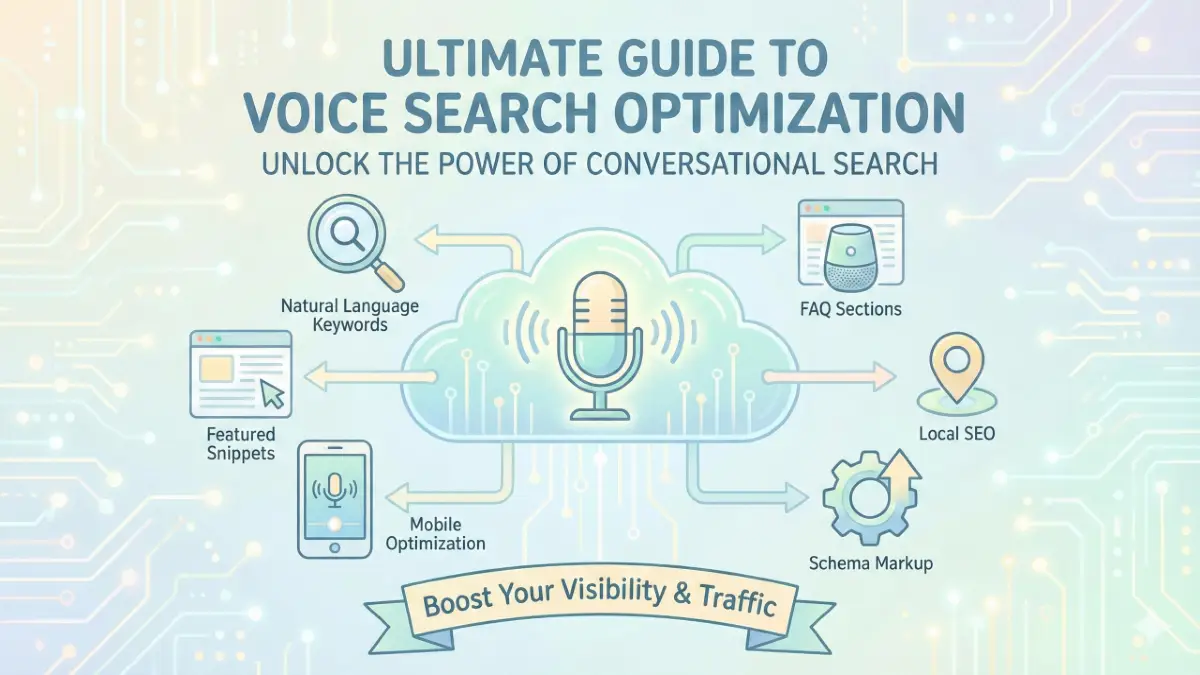
Last Updated on March 21, 2026 by Vinod Saini
Quick Answer: Voice search optimization in 2026 means structuring your content to answer spoken, conversational queries directly — so AI assistants, Google’s featured snippets, and AI Overviews pull your content as the spoken response. With 8.4 billion voice assistants now active globally and India leading adoption among emerging markets, this is no longer an optional SEO tactic.
Introduction: Your Rankings Can Drop Without You Typing a Single Keyword
Here is something most business owners do not realize until it is too late.
A customer in Delhi asks Google Assistant: “Which SEO agency near me is good for online stores?” Google reads out one answer. One website gets the mention. Every other ranked page gets nothing — no click, no traffic, no lead.
That is voice search in 2026. And it is happening billions of times a day, across every sector — retail, healthcare, education, hospitality, real estate.
The rules for voice search optimization are fundamentally different from traditional SEO. You are no longer just ranking for keywords. You are competing to be the single spoken answer that an AI assistant reads out loud.
This guide gives you a practical, up-to-date framework: what changed in 2026, why your current SEO approach may leave you invisible, and exactly what to do about it — whether you run an eCommerce store, a professional services firm, a clinic, a school, or a D2C brand.
How Big Is Voice Search in 2026? The Numbers That Matter
Voice search has crossed from trend to mainstream.
8.4 billion voice assistants are now active worldwide — more devices than the global population. Around 50% of U.S. consumers use voice search daily, and India leads global growth in voice adoption, driven by affordable smartphones, regional language support, and the massive expansion of Google Assistant usage.
Key data points every business needs to know:
-
58% of voice searches are for local business information — “near me” queries, hours, directions, and reviews
-
Voice commerce is projected to hit $80 billion globally by end of 2026, driven by voice-activated shopping on mobile and smart speakers
-
27.6% of internet users aged 16–64 worldwide now use a voice assistant every week
-
Voice queries average 29 words — far longer and more conversational than typed searches
For Indian businesses: voice search in India increasingly happens in Hindi, Tamil, Bengali, and other regional languages, not just English. Google Assistant and Alexa both support major Indian languages, which means your content strategy needs to account for regional intent as much as English queries.
How Voice Queries Differ From Typed Searches (And Why It Changes Everything)
Nobody types the way they speak. And nobody speaks the way they type.
A person typing might enter: SSC CGL coaching Delhi. The same person speaking might ask: “What is the best SSC CGL coaching institute near Kashmiri Gate Delhi for working professionals?”
That 29-word spoken query carries clear intent, location, audience, and context — all in one sentence.
This shift from keyword-matching to intent-matching is why traditional SEO tactics alone no longer win in voice search. AI systems powering Google Assistant and Siri do not look for your primary keyword. They look for the most direct, trustworthy, contextually accurate answer to a complete question.
Voice search also strongly favors:
-
Local results — “near me” and city-specific queries dominate voice
-
Mobile-first pages — most voice searches happen on smartphones
-
Direct answers — one clear response wins, not a list of ranked links
-
Established authority — AI systems increasingly prioritize E-E-A-T signals before surfacing a spoken answer
How to Target Conversational Keywords for Voice Search
The starting point for voice search SEO is building a keyword strategy around questions, not just short phrases.
Tools like AnswerThePublic and Google’s “People Also Ask” show you the exact questions your audience asks. Look for patterns starting with: who, what, when, where, why, how, which, can, does, is. These are your voice search entry points.
Practical approach for different business types:
-
eCommerce / D2C: Target “Which [product] is best under [price] in India?” and “Where can I buy [product] with same-day delivery in [city]?”
-
Healthcare: Target “What is the best treatment for [condition] in [city]?” and “Which hospital near me treats [condition]?”
-
Education: Target “What is the fee structure for [course] at [college]?” and “How do I get admission to [institution]?”
-
Real estate: Target “Which builder is best for 2BHK flats under [budget] in [area]?”
-
Travel: Target “What are the best hotels near [landmark] in [city]?”
For each target query, write content that leads with a direct, 40–60 word answer in the first paragraph — the format AI assistants most commonly extract for voice responses.
🎯 Expert tip: Take your top 10 service or product pages and read the opening paragraph out loud. If it does not answer one specific question clearly in under 60 words, rewrite it. That single change improves your voice search eligibility more than almost any other fix.
Win Featured Snippets — The Gateway to Voice Visibility
40–60% of voice responses come directly from featured snippets — position zero on Google’s SERP.
If you do not appear in featured snippets for your key queries, you are almost entirely invisible to voice search users.
The most reliable snippet formats for voice:
-
Paragraph snippets (40–60 words) — ideal for definitional and “what is” queries
-
Numbered list snippets — ideal for step-by-step “how to” content
-
Table snippets — ideal for comparison and data queries
-
FAQ snippets — ideal for question-based long-tail queries
Structure every major section of your content with a question as the H2 or H3 heading and a direct, well-constructed answer as the first 1–2 sentences under it. Google’s AI extracts this pattern consistently for voice responses.
Schema Markup: The Technical Signal That Voice Search Cannot Ignore
Schema markup tells Google’s AI exactly what your content is — so it can confidently extract and use it as a voice response.
Use JSON-LD format for all schema implementation — it is Google’s preferred format and the easiest for crawlers to extract. Add FAQPage schema to every blog post. Add LocalBusiness schema to your homepage and contact page. Add HowTo schema to any step-by-step guide.
💡 Real example: A Delhi-based clinic added LocalBusiness and FAQPage schema to their homepage and top service pages. Within 6 weeks, they appeared in Google’s local voice pack for three “near me” healthcare queries — without any change to their rankings. Schema alone changed their voice visibility entirely.
Site Speed and Mobile Readiness: The Non-Negotiable Foundation
Voice search runs on mobile. And mobile users abandon pages that load in more than 3 seconds.
Your Core Web Vitals directly affect voice search eligibility:
-
Largest Contentful Paint (LCP): Must be under 2.5 seconds
-
Interaction to Next Paint (INP): Must be under 200ms (replaced FID in March 2024)
-
Cumulative Layout Shift (CLS): Must be below 0.1
Test your site regularly using <a href=”https://pagespeed.web.dev/” rel=”nofollow” target=”_blank”>Google PageSpeed Insights</a>. Fix image compression, enable browser caching, use a CDN for Indian visitors, and remove render-blocking JavaScript.
A fast, mobile-friendly site is not just good for user experience. It is the baseline Google requires before considering your content for voice responses at all.
Voice Search for AI Overviews and Conversational AI Platforms
In 2026, voice search and AI Overviews have converged.
When users ask Google Assistant a complex question, it no longer just reads a snippet. It generates a conversational response by pulling from multiple sources — similar to how AI Overviews work in text search.
This means your content must be optimized for conversational AI extraction, not just traditional snippet formats. Key requirements:
-
Write in a clear, logical sequence — AI systems follow content that moves from question to answer to supporting detail
-
Build entity associations — mention your brand, location, specialization, and credentials clearly throughout your content
-
Maintain consistent E-E-A-T signals — author bios with real credentials, cited sources, and first-person expert experience all increase the chance an AI system surfaces your content as a spoken response
-
Optimize across platforms — ChatGPT, Perplexity, and Claude are increasingly used for spoken queries too; the same structured, authoritative content that wins Google voice search also wins citations in these AI platforms
🎯 Action tip: On your most important service or product pages, add a short “Expert Note” or “Author Perspective” paragraph where a named professional shares their direct experience. This human signal helps AI systems identify your content as genuinely expert — not just algorithmically assembled.
Local Voice Search: Where Most Indian Businesses Win or Lose
58% of all voice queries are local in nature. For Indian businesses — especially in cities like Delhi, Mumbai, Bengaluru, Hyderabad, and Pune — local voice search is where real-world customers and clients find you.
Steps to win local voice search:
-
Claim and fully complete your Google Business Profile — add real photos, accurate hours, service descriptions, and Q&A entries
-
Build consistent local citations — your business name, address, and phone number must match exactly across every directory, website, and social profile
-
Target hyper-local queries — “best accountant near Connaught Place” or “CBSE school admission near Rohini” are the kind of long-tail local queries voice assistants answer daily
-
Use regional language variants where your audience searches in Hindi or a regional language — Google Assistant handles these well and local competitors rarely optimize for them
3 New Voice Search Trends Reshaping SEO in 2026
Trend 1: Conversational Context and Multi-Turn Queries
Next-generation voice assistants now remember the previous question in a conversation. If a user asks “Who is the best dentist near me?” and then follows with “Are they open on Sunday?” — the assistant understands the second question refers to the dentist from the first.
For content creators, this means structuring related questions logically in sequence — so your FAQ section anticipates follow-up queries, not just standalone ones.
Trend 2: Hyper-Personalized Voice Results
AI systems are increasingly personalizing voice responses based on user history, location, and prior search patterns. The same query can return a different spoken answer for different users.
This makes brand visibility and consistent citation more important than ever. If your brand is regularly cited across trusted sources, AI systems are more likely to surface it even in personalized result sets.
Trend 3: Voice Search in Regional Indian Languages
India’s voice search growth is largely happening in Hindi, Tamil, Telugu, Bengali, and Marathi — not English. Brands that create genuinely useful content in regional languages — especially for healthcare, education, government schemes, and local services — have significantly less competition and much higher voice visibility in those markets.
Track and Refine Your Voice Search Performance
You cannot improve what you do not measure.
Use these tools to monitor your voice search performance:
-
Google Search Console — filter for question-based and long-tail queries to identify voice-driven traffic
-
Google Analytics 4 — segment mobile traffic and track page engagement for voice-optimized pages
-
Semrush or Ahrefs — track featured snippet wins and losses for your target queries
-
Manual voice testing — ask Google Assistant, Siri, and Alexa your target questions every month. Note which pages get read out and which do not.
Run a full voice search audit every quarter — schema accuracy, snippet rankings, mobile speed, and GBP completeness — to stay aligned with AI updates and algorithm changes.
FAQ: Voice Search Optimization in 2026
Q1. What is voice search optimization and why does it matter now?
Voice search optimization structures your content to appear as the spoken answer from AI assistants and Google. With 8.4 billion voice devices active globally and India leading adoption, it directly affects your local and organic visibility in 2026.
Q2. How is voice search different from regular SEO in 2026?
Voice search targets full, spoken questions — averaging 29 words — rather than short keywords. It prioritizes featured snippets, schema markup, local signals, and direct answers that AI assistants can extract and read aloud to users.
Q3. Which schema types help the most with voice search optimization?
FAQPage, LocalBusiness, and HowTo schemas are the highest-impact for voice. FAQPage schema alone lifts snippet eligibility by up to 40%. LocalBusiness schema powers “near me” responses for 58% of local voice queries.
Q4. How do I optimize for voice search in regional Indian languages?
Create content that answers specific questions in Hindi or relevant regional languages. Use Google’s Search Console to identify regional language queries already reaching your site, and structure answers in the same 40–60 word direct format used for English.
Q5. How do I measure whether my voice search optimization is working?
Filter Google Search Console for question-based and long-tail queries. Track featured snippet positions in Semrush or Ahrefs. Test manually by asking Google Assistant, Siri, and Alexa your target queries monthly to see which pages are cited as spoken answers.
🚀 Get Your Free Technical SEO Audit
We'll identify critical issues hurting your rankings — delivered in 24 hours, no obligation.
Get Free Audit →