SEO vs SEM: Which Strategy Works Better for Your Business
 By Vinod Saini
Last Updated on March 15, 2026 by Vinod Saini
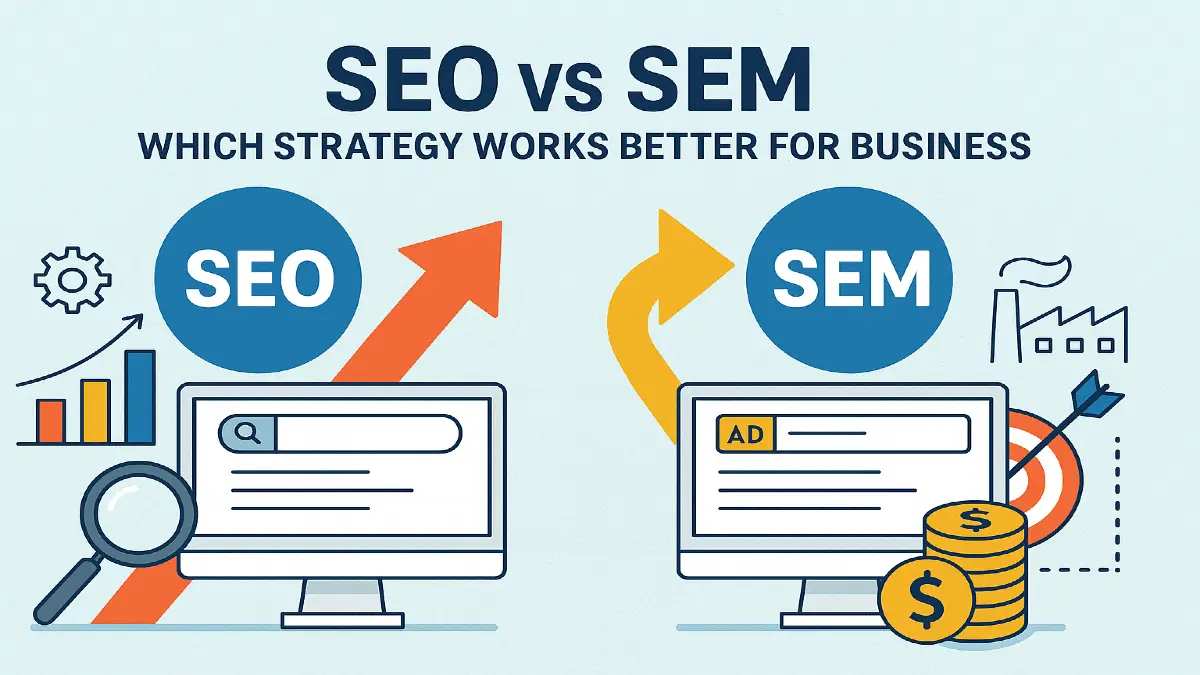
Ever wonder why some businesses show up at the top of Google every time you search — while others need to pay just to appear? That’s the SEO vs SEM difference in action. SEO builds organic visibility through smart content and technical work. SEM buys top spots with paid ads. Both work, but they play different roles in your growth.
This updated SEO vs SEM comparison breaks down the SEO vs SEM difference, shares 2026 data on SEO vs SEM ROI, and shows how to pick or blend SEO vs SEM marketing for your business — whether you’re a small SMB, SaaS startup, e-commerce store, or service professional.
SEO vs SEM Difference: The Basics
Search Engine Optimisation (SEO) improves your unpaid rankings through content quality, technical excellence, backlinks, and user experience. It’s like planting a garden that grows stronger over time.
Search Engine Marketing (SEM) is paid advertising, mostly on Google Ads, where you bid for top positions. It’s like renting prime real estate — instant visibility, but it stops when you stop paying.
SEO algorithms weigh E-E-A-T (Experience, Expertise, Authoritativeness, Trustworthiness), content relevance, and user signals. SEM success depends on bids, Quality Score (relevance + landing page experience), and ad copy.
For small businesses, the SEO vs SEM in detail choice often comes down to patience vs budget: organic growth takes months but compounds; paid results start immediately but require ongoing spend.
SEO vs SEM: Data-Driven Comparison (2026 Metrics)
Here’s how SEO vs SEM stack up based on recent benchmarks:
Organic results claim the majority of clicks, proving SEO’s edge in SEO vs SEM which is better for volume and cost efficiency.
SEO Advantages: Sustainable Growth That Compounds
SEO builds value that keeps paying off. Organic search generates 53.3% of all website traffic and leads at $31 per conversion — 84% cheaper than the $198 industry average.
Key strengths:
-
Long-tail keywords like “SEO vs SEM for small business” convert 2.5x better because they match precise intent.
-
Semantic SEO with LSI terms (“keyword difficulty vs search volume,” “PPC vs organic traffic,” “Core Web Vitals”) signals topical authority. (Link “Core Web Vitals” to your technical pillar page.)
-
AI Overviews compatibility: Structured content with stats, FAQs, and entities ranks in summaries.
Challenges? Algorithm updates — but 70% of consistent optimisers reach page 1 within 6–12 months.
SEM Strengths: Speed and Control When You Need It
SEM shines for immediate results. Average CPC is rising (~$2.69+), but optimised campaigns deliver strong ROI through targeting.
Advantages:
-
Instant visibility: Top ad spots in hours, perfect for launches or seasonal spikes.
-
Precision targeting: Demographics, devices, remarketing — recover 70% of abandoned carts.
-
Quality Score multiplier: Here’s a key insight — good SEO actually makes SEM cheaper. A well-optimised landing page from your SEO work boosts Quality Score (which factors relevance, CTR, and page experience), lowering your CPC and improving ad rank even when you bid less than competitors.
For e-commerce and high-intent services, SEM drives ~20% of revenue despite lower traffic share. But it stops when budget does — 50% of spend can waste on unoptimised keywords.
SEO vs SEM ROI: Which Pays Off Faster?
SEO ROI: Median 748% ($22 return per $1 invested), with B2B SaaS hitting 702% after ~7 months. It takes time but compounds indefinitely.
SEM ROI: 150–300% short-term, but requires continuous spend. Great for testing demand or funding SEO while it matures.
For SMBs under $5K/month budget, SEO wins on cost per lead. E-commerce and events lean SEM for speed. SEO vs SEM ROI comparison shows hybrids often deliver the best of both.
Keyword Gaps and Long-Tail Opportunities
Head terms like “SEO vs SEM” (10K–50K searches, high KD) are competitive. Target these gaps:
-
“SEO vs SEM for small business” (1K–5K vol, medium KD)
-
“SEO vs SEM ROI comparison” (500–2K vol, medium KD)
-
“PPC vs organic traffic costs” (~800 vol, low KD)
These match transactional intent and convert 2x higher.
Hybrid SEO-SEM Strategies: The Smart Play
The best SEO vs SEM marketing blends both:
-
Use SEM data to fuel SEO: Test keywords with ads, then build organic content clusters around winners. (Link “Content Clusters” to your content marketing page.)
-
Retarget organic traffic: SEM recovers visitors who bounce from your SEO pages.
-
Budget allocation: 60–70% SEO for sustainability, 30–40% SEM for speed.
B2B and e-commerce report 2.3x traffic and 300%+ ROI from hybrids.
SEO vs SEM in the AI Overviews Era
AI Overviews appear in ~31% of searches, reducing clicks but rewarding structured content.
SEO adapts by:
-
Optimising for zero-click (FAQs, stats, tables).
-
Building topical authority clusters.
SEM adapts with AI-powered bidding, Performance Max, and intent signals over keywords.
Zero-click opportunity: While CTR drops, appearing in an AI summary for a commercial query builds brand favourability. Students or buyers see your name mentioned alongside competitors, which pays off when they later search your branded terms (“[Your Brand] pricing,” “apply to [Your College]”).
SEO vs SEM which is better for AI? SEO for authority; SEM for testing AI ad formats.
UX and Technical Fixes for Better Results
Both strategies benefit from:
-
Core Web Vitals (LCP <2.5s). (Link already in SEO section.)
-
FAQ schema and HowTo markup.
-
Jump links and scannable content (short paragraphs, bullets).
These lift dwell time 30%+, improving Quality Score (SEM) and rankings (SEO).
Actionable Steps: SEO, SEM, or Both?
-
Audit your site: Identify quick SEO wins and SEM opportunities.
-
Test SEM on high-intent terms: Validate demand, gather data.
-
Build SEO around winners: Content clusters, technical fixes.
-
Monitor hybrid performance: Adjust based on ROI and attribution.
Small businesses often start SEO-focused, adding SEM as budget grows.
FAQs
1. What’s the main SEO vs SEM difference?
SEO is unpaid organic rankings through content and authority. SEM is paid ads (Google Ads) for instant top spots. SEO builds long-term; SEM delivers speed.
2. In SEO vs SEM, which is better for small businesses?
SEO for sustainable growth at lower cost ($31/lead vs $50–200). SEM for quick launches or testing. Start SEO, layer SEM as you scale.
3. How does SEO vs SEM ROI compare?
SEO: 748% median ($22 per $1). SEM: 150–300% short-term. SEO compounds; SEM needs ongoing spend.
4. Can businesses combine SEO and SEM effectively?
Yes — hybrids yield 2.3x traffic. Use SEM to test keywords, SEO to own them long-term; retarget organic visitors.
5. How do AI Overviews change SEO vs SEM?
AI rewards structured SEO content (FAQs, entities). SEM adapts with AI bidding. SEO builds authority; SEM tests AI ad formats. Brand favourability from AI mentions boosts later branded searches.
🚀 Get Your Free Technical SEO Audit
We'll identify critical issues hurting your rankings — delivered in 24 hours, no obligation.
Get Free Audit →