What is DA and PA in SEO – Guide to Domain & Page Authority
 By Vinod Saini
Last Updated on March 15, 2026 by Vinod Saini
If you’ve ever wondered why some websites consistently rank at the top of Google while yours struggles to break page one — DA and PA might hold the answer. Domain Authority (DA) and Page Authority (PA) are two of the most widely used SEO metrics, developed by Moz, that predict a site’s or page’s ability to rank in search results. This 2026 guide covers everything: what these scores mean, how they’re calculated, how they compare to Ahrefs DR, and step-by-step strategies to improve them — whether you’re an SEO professional, startup founder, managing a healthcare website, or running an e-commerce brand.
What Domain Authority Really Means
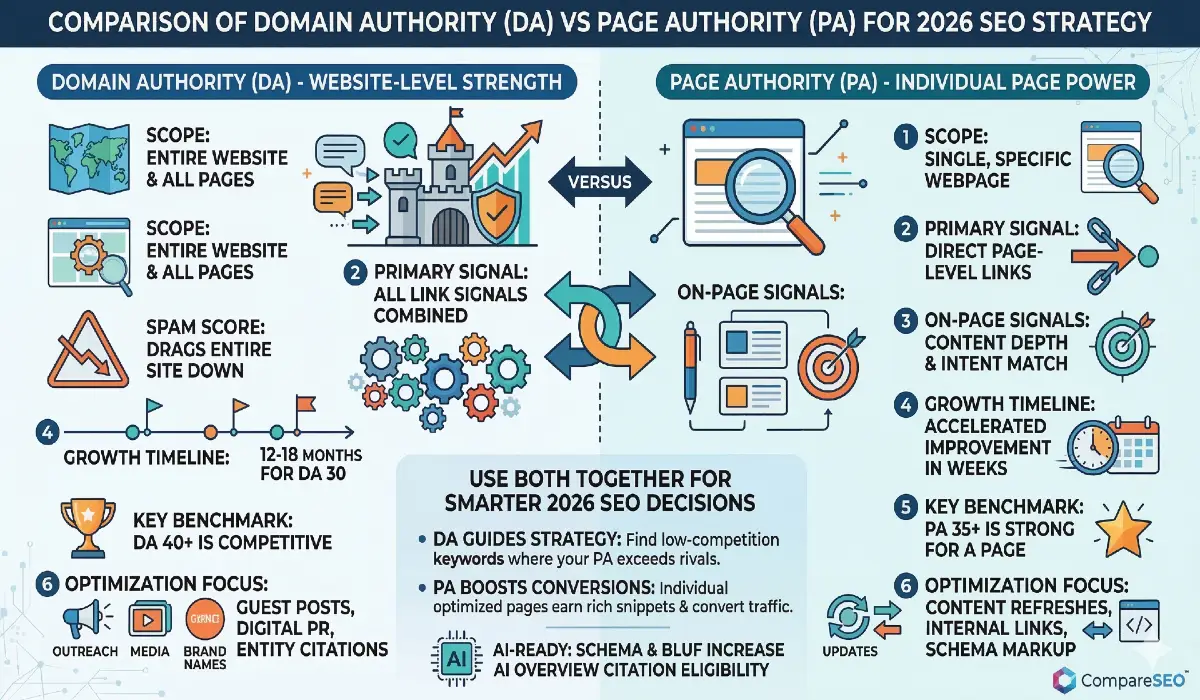
Moz launched Domain Authority in 2012 as a machine learning score on a scale of 1 to 100. Higher scores indicate stronger ranking potential relative to competitors. SEOs use DA to benchmark sites — for example, Forbes sits at DA 95 while a niche startup blog may hover around DA 25–35.
According to 2026 data, only 8.3% of all websites have a DA of 40 or above, which means even moderate improvement puts you ahead of most of the web. Sites that climb from DA 30 to DA 40 see an average 67% increase in organic traffic.
Here’s how DA ranges break down by site maturity:
-
DA 1–20: New or low-authority domains, struggle with competitive keywords
-
DA 21–40: Small businesses and early-stage content sites — the most common range globally
-
DA 41–60: Strong authority with consistent content and quality backlinks
-
DA 61–80: Established, trusted brands often cited in AI summaries and media
-
DA 81–100: Global publishers like Forbes, HubSpot, and Wikipedia
Core Factors Driving DA Scores
Moz analyzes 40+ signals monthly, but these carry the most weight:
-
Link Profile Strength: High-quality inbound links from unique root domains are the #1 factor — referring domain diversity directly drives DA
-
Spam Score — Now a Faster-Moving Risk in 2026: Moz’s Spam Score flags suspicious backlink patterns, and in 2026, Google’s manual review systems have become significantly more responsive to link manipulation signals. A Spam Score above 10–15% doesn’t just drag your DA down — it can now accelerate a manual action from Google’s webspam team faster than it did even two years ago. Sites with toxic backlink profiles are seeing penalties within weeks rather than months. The fix? Regular backlink audits using Moz Link Explorer and Google Search Console, followed by targeted disavow submissions. We help clients cleanse their backlink profiles through structured link audits — identifying toxic referring domains, submitting disavow files, and rebuilding with legitimate DA 40+ editorial links. If your DA has stagnated or dropped suddenly, your Spam Score is the first place to look.
-
Domain Diversity: Links from 100+ unique referring domains measurably lift your DA score
-
Trust Signals: Relevance from authoritative entities like Wikipedia, .edu, and .gov sites boosts credibility
-
Domain Age: Sites over 5 years tend to carry higher baseline authority
New sites typically take 12–18 months to reach DA 30 with consistent backlink and content effort.
Page Authority: Why Individual Pages Matter
Page Authority (PA) targets specific webpages on the same 1–100 scale. It’s your best diagnostic tool for understanding why a competitor’s individual blog post outranks yours — even when your overall domain is stronger.
A well-optimized PA 50 page on “best SEO tools” can beat a DA 70 generic domain through targeted, intent-matched content. In competitive SERPs, pages with strong PA tend to see significantly higher click-through rates because they’re built around a user’s exact search need — not just general relevance.
Key Influences on PA
-
Page-Level Backlinks: Dofollow links from high-PA pages transfer link equity directly to your target page
-
Content Depth: Comprehensive, topic-covering content consistently outperforms thin pages in competitive SERPs
-
Internal Linking: 5–10 contextual links from your strongest site pages distribute authority effectively
-
On-Page Optimization: Proper keyword placement, LSI terms like “link equity” and “authority score,” and semantic structure all contribute
-
User Engagement: Lower bounce rates and longer dwell time correlate with higher PA over time
DA vs PA vs DR: The 2026 Metrics Breakdown
Top SEOs in 2026 use all three metrics — Moz DA, Moz PA, and Ahrefs DR — for a complete competitive picture. DR (Ahrefs) counts raw referring domains with full transparency; DA and PA factor in Moz’s proprietary trust and spam models. Combining all three gives you the most accurate authority view for any niche.
Industry DA Benchmarks
Not all industries start from the same baseline. Here’s where your sector typically stands:
If you’re an SMB, startup, or D2C brand, targeting DA 35–50 within your first 12 months is a realistic and impactful goal.
How Moz Calculates DA and PA
Moz’s algorithm processes billions of URLs via its web index. Machine learning weighs three core layers:
-
Inbound Link Metrics: Quantity, quality, and relevance through PageRank-like flow
-
Spam Detection: Penalizes manipulative link patterns, private blog networks, and sitewide footer links
-
Semantic Relevance: Entity analysis that matches your content to your niche topic cluster
Updates happen approximately monthly. Since E-E-A-T was reinforced in Google’s core updates, demonstrated expertise and authoritativeness have become increasingly important signals that correlate with strong DA and PA performance.
Why Track DA and PA
Google doesn’t use DA or PA as direct ranking factors — but these metrics guide smarter SEO decisions across the board:
-
Competitor Benchmarking: Find keywords where your PA already exceeds rivals and double down on those pages
-
Link Prioritization: Only pursue backlinks from DA 40+ sites that are topically relevant to your niche
-
Content Planning: Use DA to gauge where you realistically stand vs. competitors before targeting a keyword
-
Outreach Efficiency: A DA 60 contextual backlink always outperforms an irrelevant DA 85 link — relevance beats raw score
DA, PA, and the Rise of GEO & AI Overviews
This is the most significant shift in 2026 SEO. Google AI Overviews, ChatGPT, and Perplexity now synthesize answers instead of just listing links — and high-authority sites get cited far more frequently in these AI-generated responses.
Generative Engine Optimization (GEO) is how you ensure your content gets cited in AI summaries. AI models strongly prefer well-structured, high-authority sources. Sites with strong DA and clear schema markup are significantly more likely to appear in AI Overview citations and conversational AI answers.
To align your DA/PA strategy with GEO:
-
Add summary paragraphs at the end of every major section — these are the “chunks” AI systems most commonly extract and quote
-
Implement FAQPage, HowTo, and Organization schema across your key pages
-
Build entity authority by earning citations alongside recognized industry names — Moz, Ahrefs, Semrush, Google Search Central
-
Write BLUF-style (Bottom Line Up Front) content — state your direct answer in the first sentence, then elaborate below
Brands relying solely on traditional blue-link SEO risk a projected 25% decline in organic traffic by 2026 as AI Overviews absorb more of the visible SERP real estate.
E-E-A-T and Topical Authority: DA’s Governance Layer
In 2026, a high DA alone no longer guarantees top rankings. Google’s systems increasingly reward E-E-A-T — Experience, Expertise, Authoritativeness, and Trustworthiness — and a DA 30 niche expert can outrank a DA 90 generic site when their content demonstrates genuine, first-hand experience.
Think of it this way: DA is the map showing your link reputation. E-E-A-T is the terrain — the actual quality and credibility of your expertise. Google sends users where the terrain is safe and reliable, not just where the map looks impressive.
Practical steps to strengthen E-E-A-T on any content page:
-
Show real credentials: Add a verified author bio with professional background, LinkedIn profile, and years of experience
-
Cite primary sources: Reference Moz’s official documentation, Ahrefs studies, and Google Search Central directly
-
Use first-hand examples: “We audited 150 SMB websites and found that domains with DA under 20 had zero page-one rankings in competitive niches”
-
Display trust signals: SSL certificate, clear About and Contact pages, consistent NAP (Name, Address, Phone), and a visible privacy policy
DA and PA Targets by Business Type
Different businesses need different DA targets. Here’s a practical breakdown:
SMBs & Local Services (Target: DA 25–40)
Focus on local citations, Google Business Profile optimization, and niche directory links. Even DA 30 can dominate local SERPs when competitors are hovering at DA 15–20.
E-Commerce & D2C Brands (Target: DA 35–50)
Product page PA matters as much as domain-level DA. Build PA on your top-converting product and category pages through targeted backlinks and strong internal linking from blog content.
Educational Institutions (Target: DA 50+)
.edu domains carry inherent trust signals. Focus on faculty expert content, published research citations, and earning links from other educational and government sources.
Healthcare & Professional Services (Target: DA 40–55)
YMYL (Your Money, Your Life) pages face extra scrutiny. Strong E-E-A-T, verified authorship by licensed professionals, and backlinks from medical associations and health publications are essential.
SEO Agencies & Freelancers (Target: DA 40–60)
Your DA is your credibility signal to every prospect who Googles you. Maintain an active blog, earn coverage in SEO publications, and build links through original research, case studies, and data-backed content.
Travel & Hospitality (Target: DA 35–50)
Earn links from travel publications, local tourism boards, and review platforms. PA on destination and package pages directly influences conversion traffic.
Real Estate & Construction (Target: DA 35–48)
Local authority matters most. Focus on city-specific landing pages with strong PA through internally linked neighborhood guides and developer partnership mentions.
Top Free Tools to Check DA, PA, and DR
-
Moz Link Explorer: Free DA/PA/Spam Score checks (10 queries/month) — the original and most trusted source
-
Ahrefs Website Authority Checker: Instant DR scores with referring domain count
-
Semrush Authority Score: Blends link data with organic traffic signals for a holistic view
-
MozBar Chrome Extension: Real-time PA/DA scores displayed directly in your SERPs as you browse
-
The HOTH Bulk DA Checker: Free bulk domain authority checking for multiple domains at once — ideal for competitor analysis
Step-by-Step Guide to Increase DA
A realistic timeline: +10 DA points in 3–6 months
-
Acquire quality backlinks — Guest post on DA 50+ niche sites; one strong editorial link beats ten weak directory links
-
Publish linkable assets — Original data studies, infographics, “2026 DA benchmarks,” and expert roundups earn natural links at scale
-
Fix technical SEO — Core Web Vitals above 90, mobile-first design, clean URL architecture, and crawlable internal structure
-
Disavow toxic links — Audit regularly via Google Search Console and Moz’s Spam Score filter; don’t wait until a penalty hits
-
Diversify referring domains — Target 50+ new root domains annually; domain diversity lifts DA scores faster than repeat links from the same source
💡 Need Help Building High-DA Backlinks?
Learning what DA is — and why it matters — is step one. Step two is actually acquiring the quality links that move the needle. Our Link Building Services → are designed for businesses that want real, editorial backlinks from DA 40+ niche-relevant sources — not spammy directories or PBNs.Whether you’re an SMB targeting local rankings, an e-commerce brand scaling organically, or an SEO agency white-labeling outreach — we build links that grow your DA and stick.
(Update the URL above to your actual Link Building Services page before publishing)
Fast Ways to Boost Page Authority
PA gains are achievable in weeks with the right approach:
-
Refresh existing content: Add updated 2026 stats, new examples, and fresh references — Google rewards recency on competitive topics
-
Build strategic internal links: Anchor from your 5 highest-DA pages directly to the target page you want to lift
-
Implement schema markup: FAQPage and HowTo schemas drive rich snippets and can improve CTR by up to 20%
-
Optimize for engagement: Add calculators, comparison tables, or embedded free tools to increase dwell time and reduce bounce rate
-
Earn page-level backlinks: Promote via targeted email outreach to sites already linking to similar content in your niche
Build Semantic SEO with Topical Clusters
A pillar-cluster content model amplifies both DA and PA over time by signaling topical depth to Google and AI systems alike:
-
Pillar Page: This comprehensive DA/PA guide
-
Cluster Content: “Free DA checker tools 2026,” “DR vs DA comparison,” “E-E-A-T impact on Page Authority,” “How to build topical authority for local SEO,” “Link building strategies for startups”
Link out to authoritative entities like Moz, Ahrefs, and Semrush within your content. This entity association signals topical depth to both Google’s ranking systems and AI language models.
Optimize for UX, AI Overviews, and LLMs
Structure your content for both humans and machines:
-
Jump Links / Table of Contents: Essential for long-form posts — helps users and AI systems navigate to relevant sections
-
Visual Aids: Responsive infographics, comparison tables, and schema-backed FAQs improve crawlability and snippet eligibility
-
BLUF Format: Answer the question in the first sentence of every section — this is what AI Overviews extract
-
Mobile-First Design: Over 60% of search traffic is mobile; slow or broken mobile pages hurt both PA and conversions
-
Active Voice: Human-first writing with direct sentences strengthens E-E-A-T signals throughout
Smart Backlink Strategies Using DA and PA
Prospect DA 40–60 sites for guest posts and prioritize PA 30+ landing pages for your link placements. Avoid any site with a Spam Score over 15%. Track your backlink progress monthly using Ahrefs or Moz tools.
Real-world example: A DA 60 contextual backlink placed on a PA 50 page within a relevant niche outperforms an irrelevant DA 80 link from an unrelated industry — every time. Relevance and context are the multipliers that raw score alone can’t replicate.
Busting DA and PA Myths in 2026
-
“High DA guarantees #1 rankings” — A DA 30 niche expert with strong E-E-A-T regularly outranks DA 70 generic sites on specific queries
-
“Ignore PA on strong domains” — Individual page optimization determines which specific pages earn featured snippets and convert traffic
-
“Google ranks by DA/PA” — These are third-party Moz metrics, not Google signals. Their value is as diagnostic proxies for what Google actually measures
-
“You need hundreds of backlinks” — One high-DA editorial link from a relevant, trusted source beats 100 directory submissions
Frequently Asked Questions
What is a good DA score?
The average website DA globally is just 21. DA 30–40 is a solid foundation for SMBs and startups in local or niche markets. For competitive national or global rankings, target DA 50–60+. Only 2.5% of all websites ever reach DA 80+.
How do you check DA and PA for free?
Use Moz Link Explorer (10 free checks/month), the MozBar Chrome extension for real-time SERP data, Ahrefs’ free Website Authority Checker for DR scores, or The HOTH’s bulk DA checker for analyzing multiple competitors at once.
DA vs DR: Which metric matters more?
Use both together. DR (Ahrefs) gives you raw referring domain count with full data transparency. DA (Moz) adds spam filtering and trust modeling. For backlink prospecting, check DR. For overall site health and competitive benchmarking, use DA.
Can a low DA site rank above high DA competitors?
Yes — consistently. Google prioritizes content relevance, E-E-A-T, and user intent alignment. A DA 25 healthcare blog written by a verified medical professional can outrank a DA 60 generic health site for specific patient-intent queries.
How long does it take to increase DA by 10 points?
Realistically 3–6 months with a focused strategy: quality backlinks from diverse referring domains, content upgrades targeting topic gaps, and technical SEO fixes. Brand new sites starting from DA 1 typically take 12–18 months to reach DA 30.
Does DA/PA affect visibility in AI Overviews and ChatGPT answers?
Not directly — but high-authority, well-structured content is far more likely to be cited in AI-generated summaries. Think of DA as your credibility signal: it influences whether AI systems trust your content enough to quote it in generative responses. Pair high DA with BLUF writing and schema markup for maximum AI visibility.
What’s the difference between Moz DA and Semrush Authority Score?
DA (Moz) focuses primarily on link profile quality and spam filtering. Semrush Authority Score blends backlink data with organic traffic metrics, making it useful for a broader site health check. Neither is a Google ranking factor — both are diagnostic tools to guide your SEO strategy.
🚀 Get Your Free Technical SEO Audit
We'll identify critical issues hurting your rankings — delivered in 24 hours, no obligation.
Get Free Audit →