What Are the 4 Types of SEO? Complete Beginner’s Guide to Ranking Higher
 By Vinod Saini
Last Updated on March 14, 2026 by Vinod Saini
Most business owners hear “SEO” and think of one thing — keywords. But that’s like saying “fitness” means only push-ups.
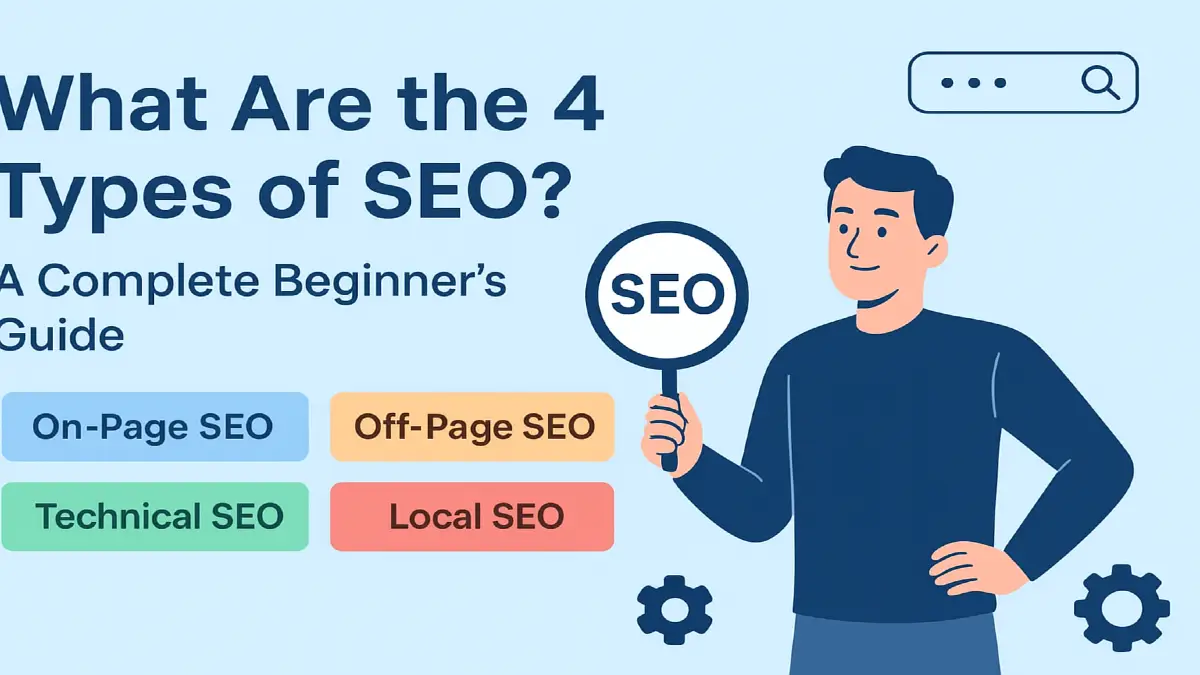
Real SEO in 2026 is a system built on four interlocking types — and missing even one of them is why most websites stay invisible on Google. Organic search still accounts for 53.3% of all website traffic, making it the single most important channel for sustainable business growth. Yet 91% of pages receive zero organic traffic — not because SEO is hard, but because most sites focus on only one or two types.
The query “types of SEO” attracts over 14,000 monthly searches, which tells you how many business owners, startup founders, and marketing teams are looking for exactly this clarity.
This guide gives it to you — in plain language, with 2026 data, real examples, and a clear path to implement all four types across your business.
Why Mastering All 4 Types of SEO Matters More
Google processes 8.5 billion searches daily. But search in 2026 doesn’t look like it did two years ago.
AI Overviews now appear on a large share of search results. AI Overview presence reduces organic CTR by 35% for traditional blue-link results. Zero-click searches are rising. Voice search, ChatGPT, and Gemini are capturing query intent that used to flow exclusively to websites.
This sounds threatening — and it is, if you’re only doing one type of SEO.
But businesses that master all four types of SEO — and layer in 2026’s newer approaches — are seeing stronger results than ever. Agencies offering complete, multi-type SEO strategies report 40% traffic gains for clients using holistic approaches. The difference between those winning and losing comes down to whether they treat SEO as a single tactic or a complete system.
What Google’s 2026 Algorithm Actually Rewards
Google’s latest core updates reinforce one consistent message: E-E-A-T (Experience, Expertise, Authoritativeness, Trustworthiness) matters most.
Pages that demonstrate genuine expertise, cite verifiable data, show real-world experience, and maintain consistent authority across all four SEO types rank significantly higher — and get cited in AI Overviews. This is no longer just a content quality signal. It’s a full-site, full-presence signal that spans everything from your schema markup to your backlink profile.
Type 1 — On-Page SEO: Craft Content That Ranks and Gets Cited
On-page SEO optimizes elements within your website to match search intent, satisfy user needs, and signal relevance to Google’s algorithms.
In 2026, position #1 generates 39.8% of all clicks in search results. Getting there requires more than keywords — it requires deeply matching user intent at every level of your page.
Keyword Research: The Foundation of On-Page Success
Target your primary terms like “types of SEO” alongside long-tail variations such as “types of SEO for small business” (high commercial intent, 1,200+ monthly searches).
Place keywords in title tags (55–60 characters), meta descriptions (150–155 characters), H1, the first 100 words, and image alt text. Use tools like Ahrefs or Semrush for intent mapping — not just volume.
Content That Earns Rankings and AI Citations
Write 1,500–2,500+ words incorporating LSI terms: topical authority, search intent types (informational, navigational, transactional), entity optimization, and E-E-A-T signals.
Use short paragraphs (2–3 lines), bullet lists, and summary tables. Rich results capture 58% of clicks compared to 41% for non-rich results in equivalent positions — schema markup is no longer optional.
On-Page SEO Checklist
-
Title tag under 60 characters with a human hook — e.g., “4 Types of SEO Explained: The 2026 Beginner’s Guide”
-
Single H1, logical H2/H3 structure with keyword variants like “different types of SEO strategies”
-
Article + FAQPage JSON-LD schema for rich snippet eligibility (30% CTR lift)
-
Readability score above 60 (Hemingway App)
-
7–10 internal links to topically related pages
-
Compressed images below 100KB with descriptive alt text
-
Direct Q&A sections and bullet summaries for AI Overview extraction
Fact: Optimized on-page elements lift rankings by up to 20% within 90 days.
Type 2 — Off-Page SEO: Build Authority That Lasts
Off-page SEO builds your website’s authority through external signals — backlinks, brand mentions, digital PR, and increasingly, AI citations. Google treats quality backlinks as endorsements, elevating your standing across all types of SEO efforts.
Pages ranking #1 carry 3.8x more backlinks than pages in positions 2–10. But in 2026, the nature of off-page authority has expanded beyond links alone.
Backlink Strategies That Deliver Real Results
Pursue guest posts on DR 70+ sites in your niche, broken link building (Ahrefs makes this easy with its 500M+ referring domain index), and skyscraper content that outperforms existing top results in depth and accuracy.
Digital PR secures mentions in Forbes, Economic Times, or TechCrunch — these build brand authority signals that AI systems recognize and trust. Aim for 50+ quality referring domains from relevant, authoritative sources.
Brand Signals: The Off-Page Evolution
Unlinked brand mentions add measurable authority — 25% authority lift for consistent mentions across forums, news sites, and industry publications.
Share content actively on LinkedIn (highest B2B engagement) and X. Posts with visuals earn 94% more reach. Every share, mention, and citation contributes to the trust profile Google and AI engines use to decide which brands to surface.
Track your growth monthly using Ahrefs Domain Rating or Semrush Authority Score — and run link audits to disavow toxic links before they create penalties.
Type 3 — Technical SEO: Unlock Crawling, Speed, and Indexability
Technical SEO ensures search engines can access, crawl, understand, and index your content without friction. It’s the infrastructure that makes every other type of SEO actually work.
70% of sites currently fail Core Web Vitals benchmarks — meaning most websites are leaving rankings on the table before a single content decision is made.
Optimising Core Web Vitals
-
LCP (Largest Contentful Paint): Under 2.5 seconds — compress images below 100KB via TinyPNG, deploy a CDN like Cloudflare
-
INP (Interaction to Next Paint): Under 200ms — minimize JavaScript execution and third-party scripts
-
CLS (Cumulative Layout Shift): Under 0.1 — use explicit size attributes for all images and embeds
-
Mobile traffic: 63% of all organic search traffic now comes from mobile devices — mobile-first design isn’t optional
WP Rocket and similar performance plugins can cut load times by up to 50% for WordPress sites.
Indexing and Crawl Health Essentials
Submit XML sitemaps to Google Search Console and monitor for crawl errors weekly. Fix 404s promptly. Use canonical tags to prevent duplicate content dilution — particularly critical for e-commerce stores and D2C brands with product variant URLs.
Add hreflang tags for multilingual or multi-region sites. HTTPS is non-negotiable — it’s both a ranking signal and a user trust signal. Clean robots.txt ensures crawl budget goes to your most valuable pages.
Stat: Technical SEO fixes yield 15–20% traffic improvements within 60 days for most audited sites.
Type 4 — Local SEO: Capture Nearby Customers Who Are Ready to Buy
Local SEO targets location-based queries — “near me” searches, city-specific terms, and Google Maps results. These aren’t casual browsers. They’re buyers.
46% of all Google searches have local intent, and 76% of local searchers visit a business within 24 hours of searching. For SMBs, healthcare providers, real estate agencies, restaurants, and professional services, local SEO is often the fastest path to direct revenue.
Google Business Profile: Your Local SEO Command Centre
Claim and verify your profile. Fill every section — services, hours, photos (20+), attributes, and your business description with natural keyword integration.
Post weekly updates. Respond to every review — 88% of people trust online reviews as much as a personal recommendation. Consistent engagement signals active business credibility to Google’s local ranking systems.
Citations and Local Authority Building
List your business on Justdial, IndiaMART, Sulekha, and 50+ relevant directories. Ensure your NAP (Name, Address, Phone) is identical across every listing — even small inconsistencies hurt local pack rankings.
Target location-specific keywords throughout your site: “types of SEO services in Delhi,” “digital marketing agency in Mumbai,” “SEO company near me.” Create dedicated landing pages for each major location you serve — these consistently outperform generic “we serve all of India” pages.
The 4 Types of SEO: Quick Reference
New in 2026: Three SEO Types You Now Need to Know
5. Semantic SEO — Entity-First, Topical Authority
Semantic SEO goes beyond individual keywords to build topical authority — signalling to Google that your site deeply covers an entire subject area, not just isolated pages.
Connect your “types of SEO” pages to your on-page and off-page guides. Cover subtopics: voice search optimization, featured snippets, E-E-A-T implementation, zero-click strategy. Use natural language that LLMs can parse: direct statements, clear definitions, data-backed claims. FAQ schema boosts AI Overview citation eligibility by up to 35%.
6. GEO — Generative Engine Optimization
GEO (Generative Engine Optimization) is the practice of structuring your brand presence so AI search tools — Google AI Overviews, ChatGPT, Gemini, Perplexity — cite your business as a trusted source.
This isn’t just about content quality. It requires consistent brand mentions across authoritative platforms, structured data that AI can parse, and location-specific context that matches how AI systems interpret local intent. For local businesses across India, GEO is quickly becoming as important as traditional local SEO.
7. AEO — Answer Engine Optimization
AEO (Answer Engine Optimization) specifically targets question-based queries — the ones that trigger AI Overviews, featured snippets, and “People Also Ask” boxes.
Structure your content to directly answer questions your audience asks. Use FAQPage schema, numbered lists, and concise summary paragraphs. Voice search — particularly strong across India’s mobile-first users — favours the same natural, conversational formats that AEO requires. Pages optimized for AEO appear 3x more frequently in AI-generated responses.
How to Implement All SEO Types for Top Rankings
Don’t try to do everything at once. Follow this priority sequence:
-
Start with Technical SEO — fix speed, mobile, and crawl issues first; nothing else works well on a broken foundation
-
Layer On-Page SEO — optimize existing pages before creating new content; quick wins with existing traffic
-
Build Local SEO — claim and optimize your GBP; this drives real enquiries within weeks
-
Scale Off-Page SEO — start link building and digital PR once your site is solid
-
Add Semantic, GEO, and AEO — build topical clusters and AI-ready content for long-term authority
Track progress monthly via Google Search Console and Semrush. Expect initial improvements in 30–45 days and meaningful ranking gains within 3–6 months.
Real-World Example: Multi-Type SEO in Action
A D2C skincare brand in India applied all four types simultaneously — technical audit (fixed 18 CWV failures), on-page optimization (rewrote 30 product pages), local SEO (GBP for 3 cities), and off-page (12 guest posts on health and wellness platforms).
Results at month 6: 130% increase in organic traffic, 65% growth in qualified leads, and their brand began appearing in Google AI Overviews for “best natural skincare India” — a direct result of AEO and semantic SEO work alongside the foundational four.
The lesson is consistent across SMBs, startups, e-commerce brands, and professional services: all types of SEO compound each other. One type alone delivers modest results. All types together build a ranking machine.
Frequently Asked Questions (FAQs)
1. What are the 4 main types of SEO in 2026?
The four core types are On-Page SEO, Off-Page SEO, Technical SEO, and Local SEO. In 2026, three additional types have become important for complete digital visibility: Semantic SEO, GEO (Generative Engine Optimization), and AEO (Answer Engine Optimization).
2. How many types of SEO exist in digital marketing today?
Four core types form the foundation. But with AI-powered search evolving rapidly, GEO, AEO, and Semantic SEO have become essential additions — meaning seven distinct SEO types now shape comprehensive rankings in 2026.
3. What different types of SEO services should beginners prioritize?
Start with a technical SEO audit to fix foundational issues, then optimize your top-priority on-page content. Add local SEO if you serve specific locations. Once those are solid, build off-page authority through link building and digital PR.
4. How do types of SEO impact Google AI Overviews and LLM citations?
Semantic SEO, AEO, and structured schema markup (FAQPage, Article, HowTo) directly increase your eligibility for AI Overview citations. Pages optimized with these elements appear 3x more frequently in AI-generated answers. GEO extends this to ChatGPT, Gemini, and Perplexity citations.
5. What’s a realistic results timeline when combining all types of SEO?
Technical fixes show results within 30–60 days. On-page improvements appear in rankings within 4–8 weeks. Local SEO impacts can show in 30–45 days. Off-page authority and full organic growth typically build over 3–6 months — with compounding results extending well beyond that.
🚀 Get Your Free Technical SEO Audit
We'll identify critical issues hurting your rankings — delivered in 24 hours, no obligation.
Get Free Audit →